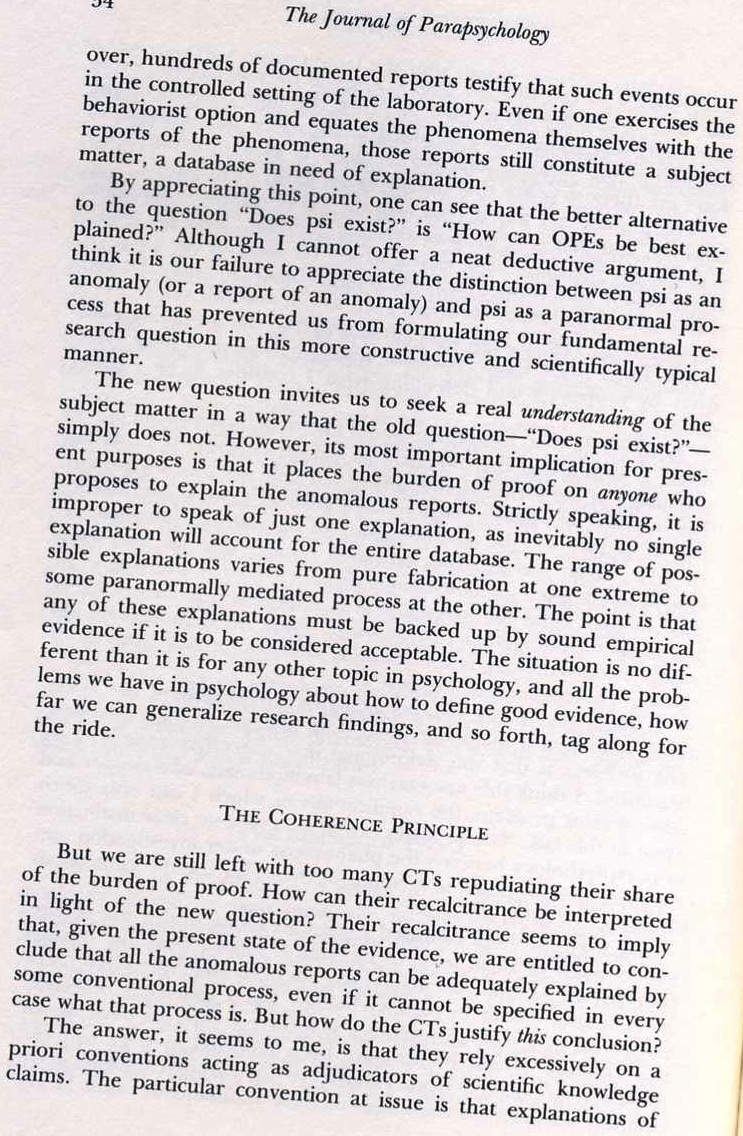
But we are still left with too many CTs repudiating their share of the burden of proof. How can their recalcitrance be interpreted in light of the new question? Their recalcitrance seems to imply that, given the present state of the evidence, we are entitled to conclude that all the anomalous reports can be adequately explained by some conventional process, even if it cannot be specified in every case what that process is. But how do the CTs justify this conclusion?
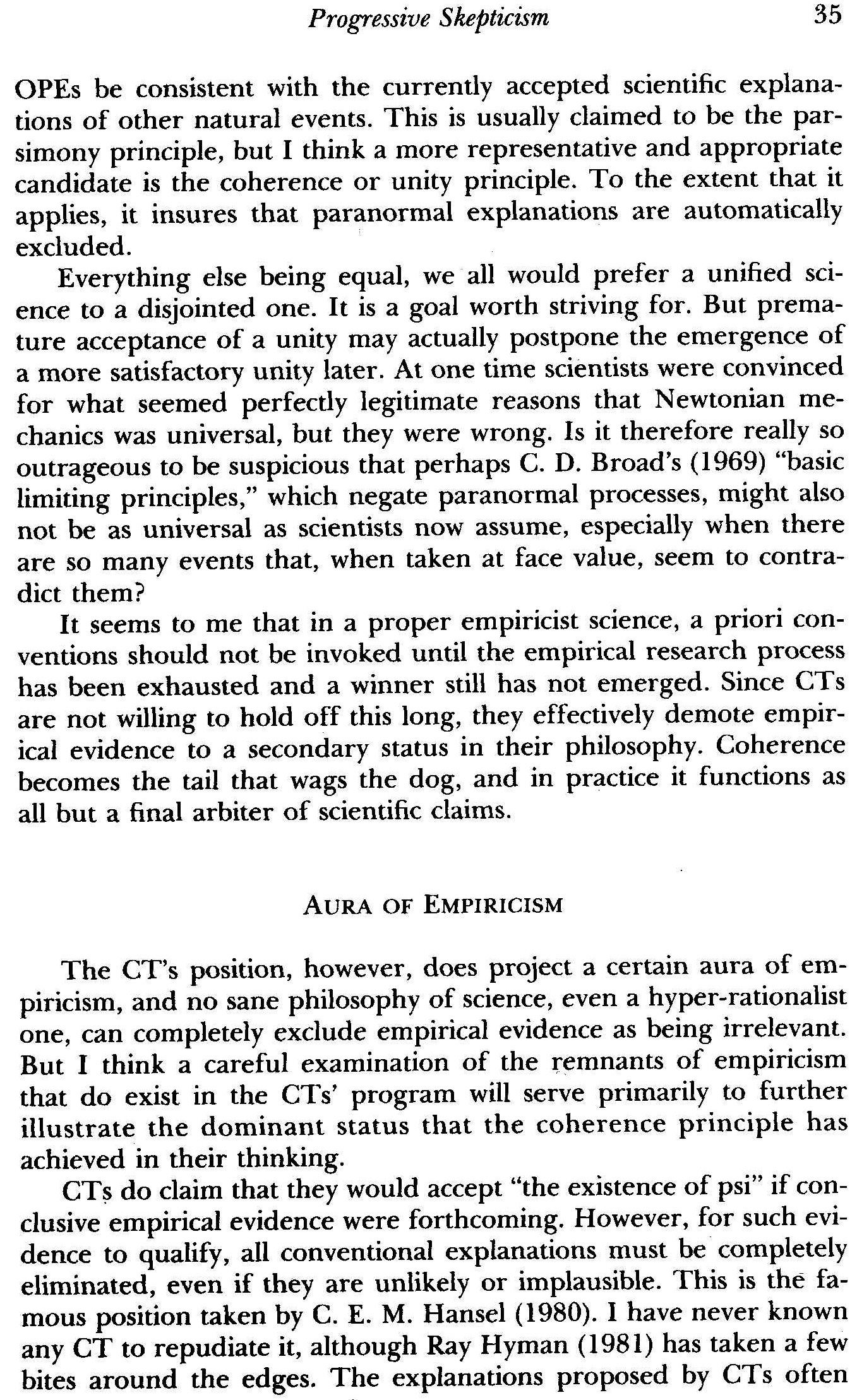
The answer, it seems to me, is that they rely excessively on a priori conventions acting as adjudicators of scientific knowledge claims. The particular convention at issue is that explanations of OPEs be consistent with the currently accepted scientific explanations of other natural events. This is usually claimed to be the parsimony principle, but I think a more representative and appropriate candidate is the coherence or unity principle. To the extent that it applies, it insures that paranormal explanations are automatically excluded.
Everything else being equal, we all would prefer a unified science to a disjointed one. It is a goal worth striving for. But premature acceptance of a unity may actually postpone the emergence of a more satisfactory unity later. At one time scientists were convinced for what seemed perfectly legitimate reasons that Newtonian mechanics was universal, but they were wrong. Is it therefore really so outrageous to be suspicious that perhaps C. D. Broad's "basic limiting principles," which negate paranormal principles, might also not be as universal as scientists now assume, especially when there are so many events that, when taken at face value, seem to contradict them?
It seems to me that in a proper empiricist science, a priori conventions should not be invoked until the empirical research process has been exhausted and a winner still has not emerged. Since CTs are not willing to hold off this long, they effectively denote empirical evidence to a secondary status in their philosophy. Coherence becomes the tail that wags the dog, and in practice it functions as all but a final arbiter of scientific claims.